

In today’s data-driven world, organizations are no longer asking whether to modernize their data warehouses—but how fast they can do it. With data volumes exploding, analytics becoming real-time, and business users demanding instant insights, traditional on-premises data warehouses often struggle to keep up.
A cloud-ready data warehouse solves these challenges by offering elasticity, performance, and cost efficiency. But designing one that truly scales—without becoming complex or expensive—requires thoughtful planning and modern architectural choices.
In this blog, we’ll explore key principles, best practices, and architectural considerations for designing a scalable, cloud-ready data warehouse that supports growth today and innovation tomorrow.
What Is a Cloud-Ready Data Warehouse?
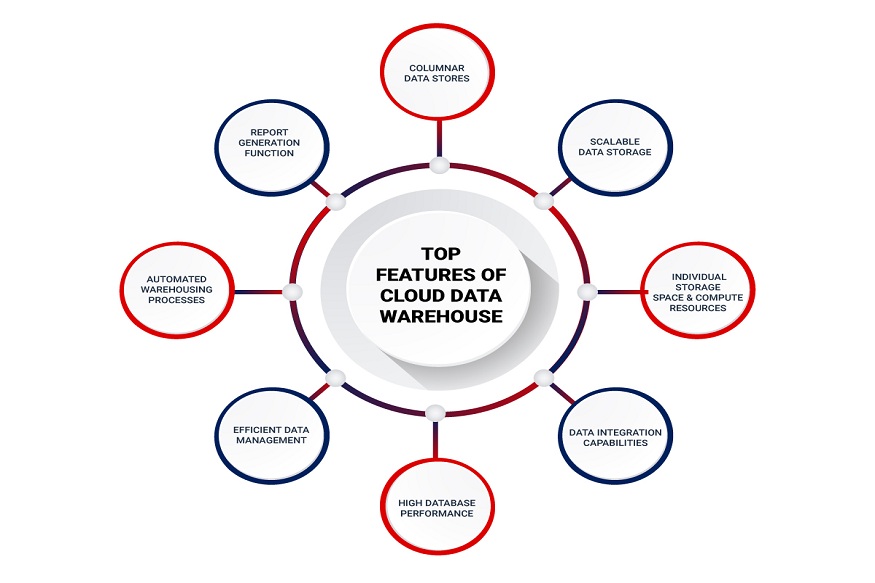
A cloud-ready data warehouse is designed to fully leverage cloud capabilities such as:
- Elastic compute and storage
- On-demand scalability
- Pay-as-you-go pricing
- High availability and resilience
- Native integration with analytics and AI tools
Unlike legacy systems, cloud-ready warehouses decouple storage from compute, allowing organizations to scale each independently based on workload demands.
? Want a Deeper Dive?
If you’re ready to go beyond the basics and learn step-by-step frameworks, reference architectures, and real-world best practices, we’ve got you covered.
? Download the free eBook: “The Complete Guide to Designing a Scalable, Cloud-Ready Data Warehouse”
Inside the eBook, you’ll discover:
- Proven cloud data warehouse architectures
- Common pitfalls and how to avoid them
- Cost-optimization strategies
- Security and governance checklists
? Download the eBook now and start building a future-proof data platform today.
Key Design Principles for Scalability
1. Separate Compute and Storage
One of the most important design principles in the cloud is decoupling compute from storage.
Why it matters:
- Scale compute for heavy queries without duplicating data
- Store massive datasets at low cost
- Avoid performance bottlenecks during peak usage
This flexibility allows teams to support multiple workloads—BI reporting, data science, and ad-hoc analytics—simultaneously.
2. Design for Elasticity from Day One
A scalable data warehouse should automatically scale up or down based on usage.
Best practices include:
- Auto-scaling clusters or virtual warehouses
- Workload isolation for different teams
- On-demand provisioning for seasonal or unpredictable usage
Elasticity ensures consistent performance while controlling costs.
3. Use a Modern Data Modeling Approach
Cloud data warehouses work best with analytics-optimized data models.
Consider:
- Star and snowflake schemas for BI workloads
- Denormalized tables for faster query performance
- Data vault modeling for agility and historical tracking
Avoid overly complex transformations upfront—cloud platforms are designed to handle large-scale processing efficiently.
Building a Cloud-Native Architecture
4. Ingest Data at Scale
Modern businesses consume data from dozens of sources—applications, IoT devices, APIs, logs, and third-party platforms.
To stay scalable:
- Support batch and streaming ingestion
- Use event-driven pipelines where possible
- Automate schema evolution and data validation
The goal is to ingest data quickly without manual intervention or pipeline rewrites.
5. Embrace ELT Over ETL
In cloud environments, ELT (Extract, Load, Transform) is preferred over traditional ETL.
Why ELT works better:
- Raw data is loaded quickly
- Transformations run inside the warehouse
- Compute power can be scaled dynamically
- Faster onboarding of new data sources
This approach improves agility and reduces operational complexity.
6. Optimize for Performance and Cost
Scalability isn’t just about handling more data—it’s about doing so efficiently.
Key optimization strategies:
- Partition and cluster large tables
- Cache frequently used datasets
- Schedule compute resources intelligently
- Monitor query performance continuously
Cloud cost management should be built into the design, not treated as an afterthought.
Security, Governance, and Reliability
7. Build Security into the Foundation
A cloud-ready data warehouse must be secure by design.
Essential controls include:
- Role-based access control (RBAC)
- Encryption at rest and in transit
- Data masking and row-level security
- Audit logging and compliance reporting
Strong governance ensures scalability doesn’t compromise trust or compliance.
8. Plan for Reliability and Disaster Recovery
Cloud platforms offer built-in resilience, but you still need a strategy.
Best practices:
- Multi-zone or multi-region deployments
- Automated backups and snapshots
- Defined recovery time objectives (RTOs)
A scalable system must remain reliable—even during failures or traffic spikes.
Future-Proofing Your Data Warehouse
9. Enable Advanced Analytics and AI
A truly cloud-ready warehouse should support:
- Real-time analytics
- Machine learning workloads
- Integration with data science tools
- Self-service BI for business users
Designing with these capabilities in mind ensures your platform evolves with business needs.
Final Thoughts
Designing a scalable, cloud-ready data warehouse is not just a technical upgrade—it’s a strategic investment. By embracing elasticity, modern architecture, automation, and strong governance, organizations can unlock faster insights, lower costs, and long-term agility.
The right design today will determine how well your data platform supports innovation tomorrow.
Ambien Buy Online
Tramadol For Sale Online
Pregabalin Online
Zolpidem 5Mg Order Online
Diazepam Without Prescription
Buy Valium 10 Mg Online
Zanaflex Discount
Best place to Buy Lyrica Online
Buy Valium Online Without Prescription